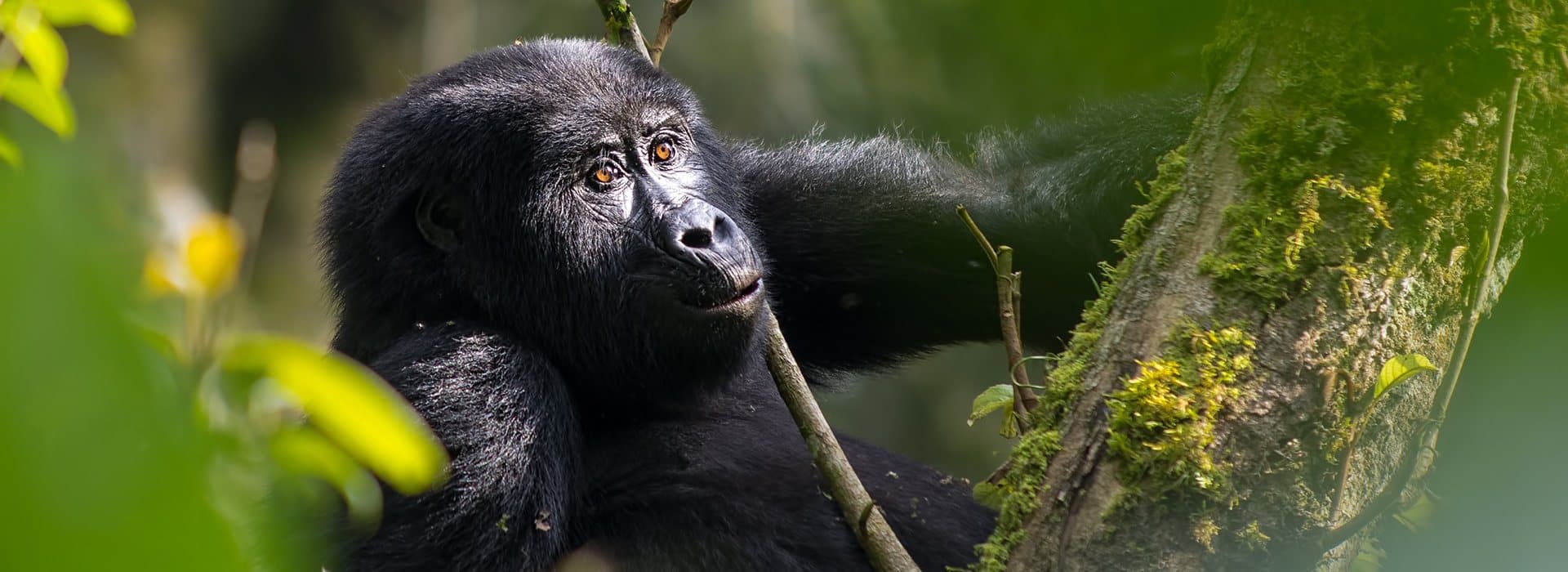
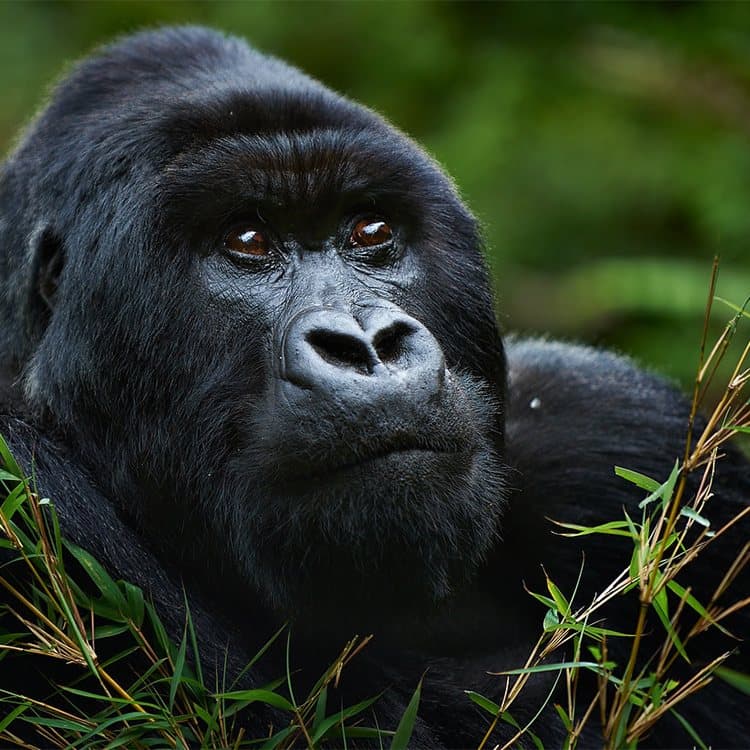
Bwindi Impenetrable National Park covers a little over 320 square kilometres of montane rainforest on the steep edge of the Albertine Rift in south-western Uganda, and the name is not marketing — the undergrowth is dense enough that trackers cut a path ahead of you with machetes. It is one of the most biologically rich forests in Africa, a refuge that survived the last ice age, and it holds roughly half of the world's remaining mountain gorillas. Trekking here is tightly controlled: a limited number of permits are issued each day, groups are capped at eight visitors, and once a habituated family is found you have exactly one hour with them. That hour, spent a few metres from a silverback while juveniles tumble through the vegetation around you, is what people travel to Uganda for.
Why visit Bwindi
- Around half the world's remaining mountain gorillas live in this single forest.
- One hour with a habituated gorilla family at close range, strictly limited to eight visitors per group.
- Ancient montane rainforest with exceptional biodiversity, including more than 350 bird species.
- The Batwa cultural experience, offering perspective on the forest's original inhabitants.
Wildlife
Mountain gorilla above all. The forest also holds chimpanzee, black-and-white colobus, red-tailed monkey, L'Hoest's monkey and forest elephant, though these are far harder to see in the dense vegetation. Bwindi is a major birding destination with over 350 species, including some two dozen Albertine Rift endemics.
- Habituated mountain gorilla families, tracked on foot
- Black-and-white colobus and L'Hoest's monkey
- More than 350 bird species, including Albertine Rift endemics
- Over 200 butterfly species
Best time to visit
June to August and December to February are the drier windows and make for less punishing trekking underfoot. Bwindi is rainforest, so rain is possible in any month and the trails are frequently muddy. Permits are limited year-round and should be secured months ahead.
June–August and December–February for drier trails.
Things to do
- Gorilla trekking
- A permit-controlled trek of one to seven hours, with one hour permitted at the sighting.
- Batwa cultural experience
- Time with the forest's original inhabitants, arranged as a separate activity.
- Forest and waterfall walks
- Guided trails through the rainforest to the Munyaga river waterfalls.
- Birding walks
- Focused walks for Albertine Rift endemics along the Mubwindi swamp trail.
How long to stay
Two nights around a single trekking day is the practical minimum, arriving the afternoon before. Three nights allows a second trek or a rest day, which many people are glad of after a long climb.
What it combines with
Bwindi is combined with Lake Bunyonyi for recovery, with Queen Elizabeth to the north for savannah wildlife, and with Kibale for chimpanzee tracking on longer circuits.

 Mid-rangeTop 10 pick